What is mental health and wellbeing research?
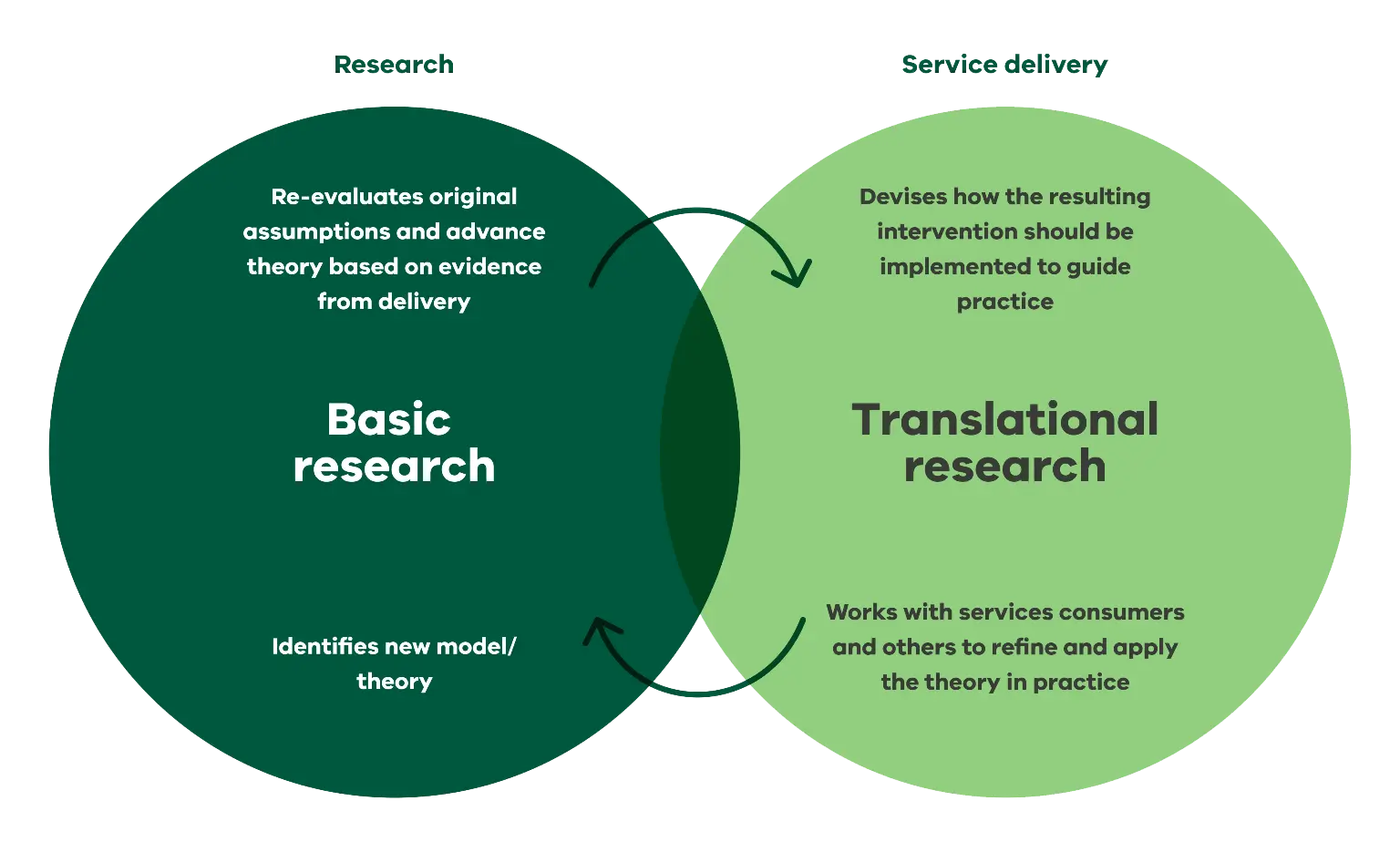
Mental health and wellbeing research refers to a wide range of activities that include understanding causes of mental illness and psychological distress, their assessment and classification and how best to respond with treatment, care and support. Research that aims to test emerging theories to develop this type of knowledge is often called ‘basic research’.
What is translational research?
Translational research, on the other hand, involves testing and applying new and enhanced treatments and models of care in service delivery environments. Its goal is to apply findings from basic research into real world settings, policy and practice, with the aim of delivering better experiences and outcomes for consumers, carers, families, supporters and kin.
Translational research is about 'accelerating the transfer of discovery to health [and wellbeing] benefit. [1] Without translational research, the direct practical benefits of basic research may not be immediately or fully realised.
To successfully translate research findings (or evidence) into practice requires feedback loops between different types of research, services, government and consumers, carers, families, supporters and kin. These loops transforms knowledge into action and action back into knowledge, through new or improved interventions and innovations, as shown in the figure below.
What is the research evidence and practice gap?
Although many interventions are shown to have promising results in trials they have mixed evidence of effectiveness when they are applied to practice and scaled. Despite research demonstrating the effectiveness of evidence-based interventions, translation into a variety of contexts often fails to flourish and therefore improvements in consumer experiences and outcomes lag behind research evidence. [1] [2]
To address this gap, growing emphasis has been placed upon the science of implementation. [3] [4] Implementation science is the study of strategies and techniques to support the uptake of evidence-based practices and research into regular use by practitioners and policy makers. [5] It is a crucial component of translational research and supports bringing together research findings and practice.
Through working with our partners, the Collaborative Centre will refine our approach to implementation science, including key principles and concepts such as readiness, barriers and enablers and strategies to overcome challenges.
The Royal Commission acknowledged the importance of ‘research that bridges the gap between ‘discovery and practice’ [to] drive high-quality care’. [6] Translational research based on the methods of implementation science provides an effective way to bridge this gap.
[2] Mary C. Ruffolo and Jeff Capobianco, ‘Moving an evidence-based intervention into routine mental health care: a multifaceted case example’, Social Work in Health Care, 51.7 (2012), 77–87.
[3] Dean L. Fixsen and others, ‘Core implementation components’, Research on Social Work Practice, 19.5 (2009), 531–540.
[6] Royal Commission into Victoria’s Mental Health System, Interim Report, p. 393.
How can translational research improve practice?
The use of translational research to share findings and improve practice can be considered to involve ‘cycles of learning’. The Royal Commission explained how cycles of learning that translate new knowledge into practice can benefit the experiences and outcomes for consumers, carers, families, supporters and kin. At a high level, cycles of learning include:
- research to establish an evidence base about effective models of mental health care.
- the capacity for innovation to test and expand the evidence base with new ideas.
- processes to capture new knowledge and ideas and translate these into practice for the benefit of mental health professionals and consumers.
- capabilities to monitor and evaluate the effectiveness and outcomes of new and established approaches to care.
- methods to curate and share information from many sources, and to use this to inform decisions and policy development for improvements across the Mental Health and Wellbeing System. [1]
[1] Royal Commission into Victoria’s Mental Health System, Final Report, Vol 5, p. 128.
Translational Research Priorities Community Survey Project
We engaged an interdisciplinary research team from the University of Melbourne to investigate community perspectives on research priorities recommended by the Royal Commission into Victoria’s Mental Health System. Two statewide community surveys were developed to collect feedback from Victorians on which research themes the Collaborative Centre should prioritise and address first. The insights from this project directly informed the development of the Collaborative Centre’s first Translational Research Strategy.
What is transformative evidence?
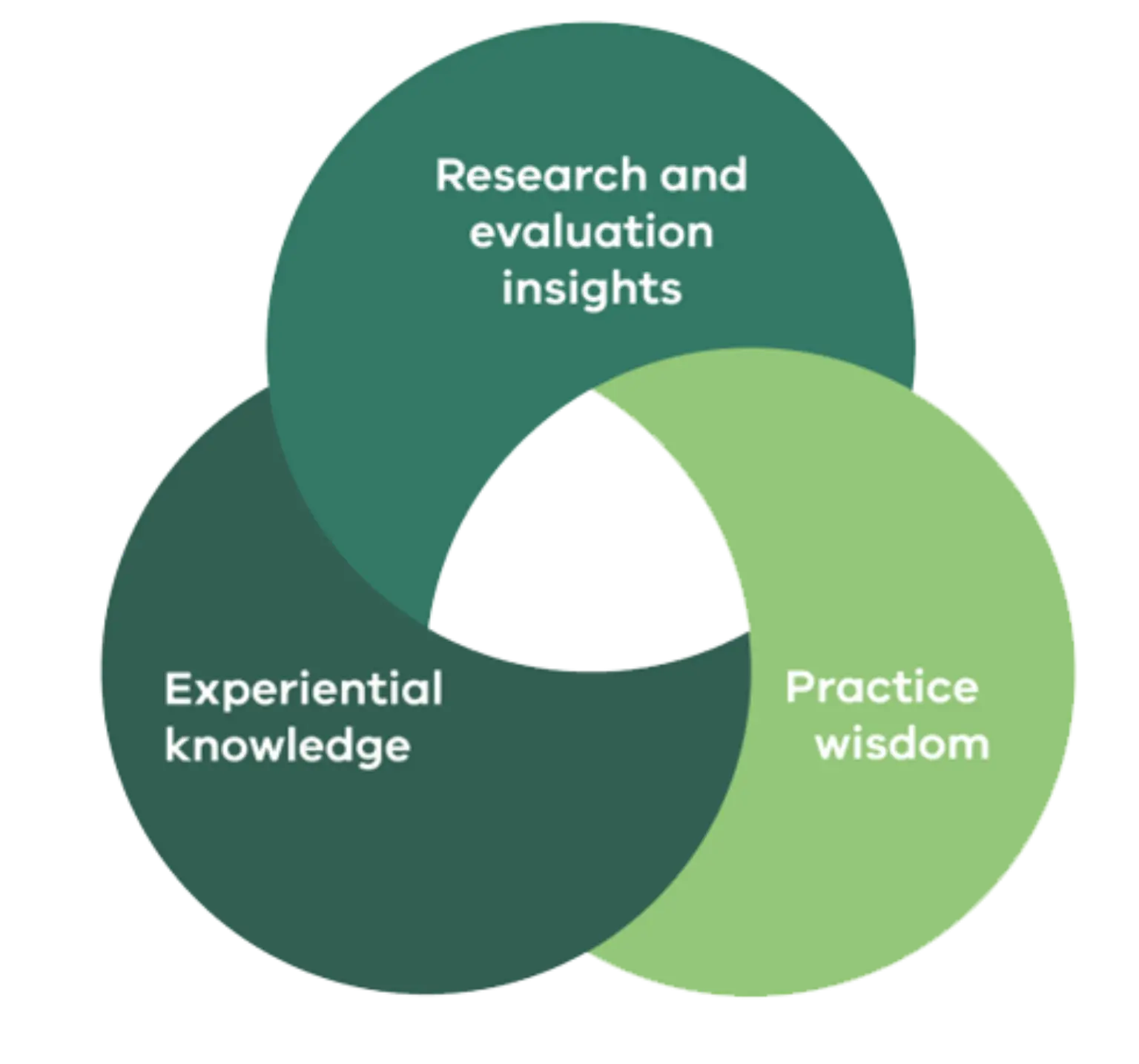
Ongoing dialogue between researchers, practitioners, consumers and their carers, families, supporters and kin ensures different types of evidence and experience are captured and embedded in the cycles of learning. This includes the experiential knowledge of people with lived and living experiences, practice wisdom from those working in care settings and research insights and evidence from academics and researchers. Collectively we refer to this as ‘transformative evidence’. You can learn more about each type of evidence in the sections below.
Transformative evidence cycle
What do we mean by experiential knowledge?
As a consumer, experiential knowledge refers to the knowledge, insights and understandings acquired through personal experience of mental ill-health or psychological distress, as well as the insights gained through experiences of service use and periods of healing and/or recovery.
As a carer, family member, supporter or kin, experiential knowledge refers to the knowledge, skills, insights and understanding acquired through the experience of supporting someone through mental-ill health or psychological distress.
Carers, family members, supporters or kin may also have knowledge, insights and understanding of navigating the mental healthcare system, developing coping strategies, seeking and utilising services to manage the emotional impacts of supporting someone who is experiencing mental health challenges—such as managing changes in relationships, balancing caregiving responsibilities with other aspects of life, and advocating for the needs and rights of the person that they are supporting.
What do we mean by practice wisdom?
Practice wisdom refers to the knowledge, skills, insights and understanding that mental health and wellbeing practitioners gain through their direct experiences of working with people experiencing mental health challenges, as well as consumers, families, carers, supporters and kin. See below list of Mental health and wellbeing.
- Aboriginal health and/or mental health practitioners
- Alcohol and other drug workers
- Carer or family peer support workers
- Case managers
- Consumer peer workers
- Counsellors
- Emergency services
- Lived experience workers
- Medical practitioners
- Nurses
- Occupational therapists
- Psychologists
- Psychiatrists
- Social workers
Each discipline has a unique scope of practice, which may or may not include the following skills and knowledge: the ability to make informed intuitive decisions based on a person's presentation (e.g., diagnosis, interventions or therapeutic approaches, developing a treatment plan), building rapport, trust, safety, confidentiality, transparency, and therapeutic relationships with consumers and carers, through being culturally responsive, and building empowerment, engagement, strong communication and relational alliances.
What do we mean by research and evaluation insights?
Research and evaluation insights refer to knowledge developed through systematic research, evaluation and analysis. This can include findings from academic research, evaluations of programs and services, and analysis of data and outcomes. These insights can help us understand what is working, what could be improved and where there are gaps in knowledge, and can inform the development and improvement of mental health and wellbeing policy, practice and services.