What is translational research?
Mental health and wellbeing research refers to a wide range of activities, including understanding the causes of mental illness and psychological distress, their assessment and classification, and how best to respond through treatment, care and support.
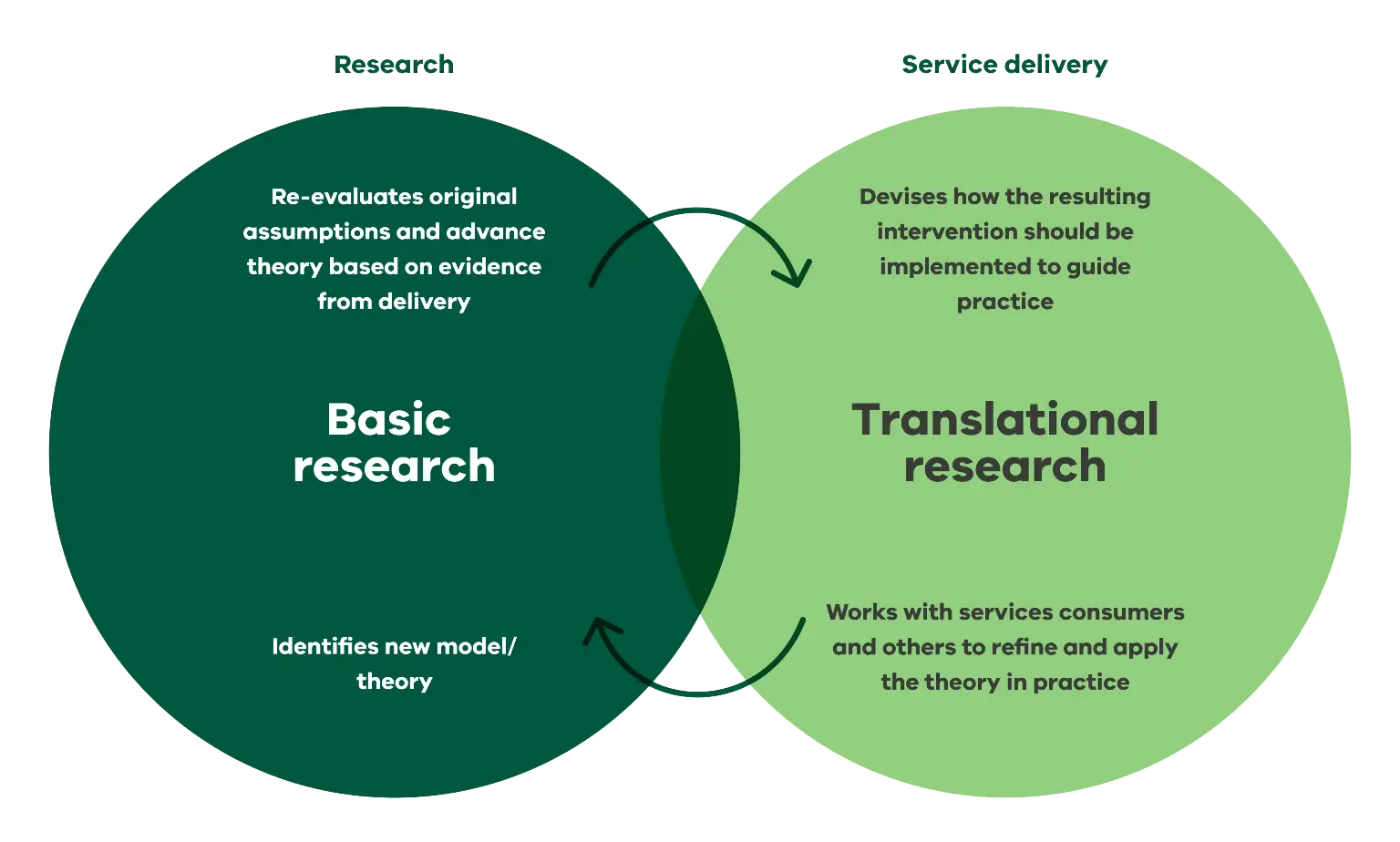
Research that aims to test emerging theories and develop this type of knowledge is often called basic research.
Translational research involves testing and applying new and enhanced treatments and models of care in service delivery environments. Its goal is to apply findings from basic research in real-world settings, policy and practice, with the aim of delivering better experiences and outcomes for consumers, families, carers, supporters and kin.
Translational research is about “accelerating the transfer of discovery to health [and wellbeing] benefit”.[1] Without translational research, the direct practical benefits of basic research may not be immediately or fully realised.
Successfully translating research findings and evidence into practice requires feedback loops between different types of research, services, government, practitioners, and consumers, families, carers, supporters and kin. These loops transform knowledge into action, and action back into knowledge, through new or improved interventions and innovations.
Closing the gap between evidence and practice
Although many interventions show promising results in trials, evidence of their effectiveness can be mixed when they are applied in practice or expanded across different settings.
Despite research demonstrating the effectiveness of evidence-based interventions, translation into a range of contexts can be difficult. As a result, improvements in consumer experiences and outcomes may lag behind the research evidence. [1] [2]
To address this gap, growing emphasis has been placed on implementation science. [3] [4]
Implementation science is the study of strategies and techniques that support the uptake of evidence-based practices and research into regular use by practitioners and policymakers. [5] It is a crucial component of translational research and helps bring together research findings and practice.
Through our work with partners, the Collaborative Centre will continue to refine our approach to implementation science. This includes considering readiness for change, barriers and enablers, and strategies for overcoming implementation challenges.
The Royal Commission into Victoria’s Mental Health System acknowledged the importance of “research that bridges the gap between ‘discovery and practice’ [to] drive high-quality care”. [6] Translational research, supported by implementation science, provides an important way to bridge this gap.
[2] Mary C. Ruffolo and Jeff Capobianco, ‘Moving an evidence-based intervention into routine mental health care: a multifaceted case example’, Social Work in Health Care, 51.7 (2012), 77–87.
[3] Dean L. Fixsen and others, ‘Core implementation components’, Research on Social Work Practice, 19.5 (2009), 531–540.
[6] Royal Commission into Victoria’s Mental Health System, Interim Report, p. 393.
Our cycle of learning
The use of translational research to share findings and improve practice can be understood as a cycle of learning.
The Royal Commission explained how cycles of learning that translate new knowledge into practice can improve experiences and outcomes for consumers, families, carers, supporters and kin.
At a high level, cycles of learning include:
- research that establishes an evidence base about effective models of mental health care
- the capacity for innovation to test and expand the evidence base through new ideas
- processes that capture new knowledge and ideas and translate them into practice for the benefit of practitioners and consumers
- capabilities to monitor and evaluate the effectiveness and outcomes of new and established approaches to care
- methods to curate and share information from many sources and use it to inform decisions, policy development and improvements across the mental health and wellbeing system.[1]
This cycle recognises that translation is not a one-way process. What is learned through implementation and practice can inform new research questions, improvements to existing approaches and future policy decisions.
[1] Royal Commission into Victoria’s Mental Health System, Final Report, Vol 5, p. 128.
The knowledge and evidence we bring together
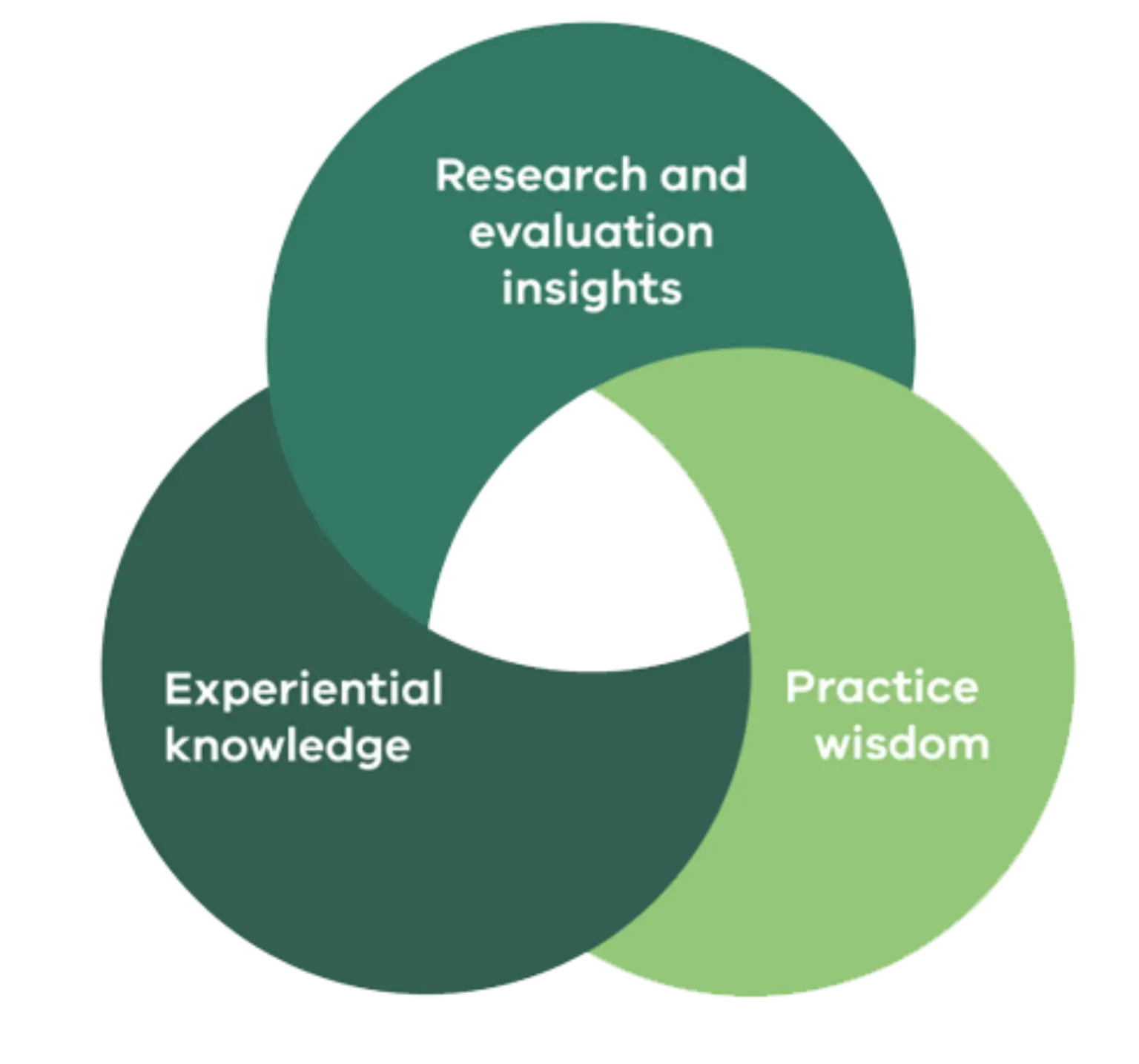
Ongoing dialogue between researchers, practitioners, consumers, and families, carers, supporters and kin helps ensure that different forms of evidence, knowledge and experience are captured and embedded within cycles of learning.
This includes experiential knowledge developed through lived and living experience, practice wisdom from people working in care settings, and insights from research and evaluation.
Collectively, the Collaborative Centre refers to these forms of knowledge as transformative evidence.
Transformative evidence cycle
Experiential knowledge
For a consumer, experiential knowledge refers to the knowledge, insights and understanding acquired through personal experience of mental ill health or psychological distress. It can include insights gained through experiences of service use and periods of healing or recovery.
For a family member, carer, supporter or kin, experiential knowledge refers to the knowledge, skills, insights and understanding acquired through supporting someone experiencing mental ill health or psychological distress.
This may include knowledge of navigating the mental health and wellbeing system, developing coping strategies, seeking and using services, managing changes in relationships, balancing caring responsibilities with other aspects of life, and advocating for the needs and rights of the person being supported.
When this knowledge contributes to leadership, research, governance, policy or professional practice, we recognise it as Lived and Living Experience expertise.
Practice wisdom
Practice wisdom refers to the knowledge, skills, insights and understanding that mental health and wellbeing practitioners gain through their direct experience of working with people experiencing mental health challenges, and with consumers, families, carers, supporters and kin.
Each discipline has a unique scope of practice. Practice wisdom may include the ability to make informed decisions based on a person’s presentation and circumstances, select appropriate interventions or therapeutic approaches, develop treatment and support plans, and build rapport, trust, safety and therapeutic relationships.
It can also include knowledge of culturally responsive practice, communication, engagement, empowerment and the practical conditions that influence how an approach works in a particular setting.
Mental health and wellbeing practitioners
Mental health and wellbeing practitioners work across a wide range of roles, disciplines and settings. They include:
- Aboriginal health and/or mental health practitioners
- Alcohol and other drug workers
- Carer or family peer support workers
- Case managers
- Consumer peer workers
- Counsellors
- Emergency services
- Lived experience workers
- Medical practitioners
- Nurses
- Occupational therapists
- Psychologists
- Psychiatrists
- Social workers
Each discipline has a unique scope of practice, which may or may not include the following skills and knowledge: the ability to make informed intuitive decisions based on a person's presentation (e.g., diagnosis, interventions or therapeutic approaches, developing a treatment plan), building rapport, trust, safety, confidentiality, transparency, and therapeutic relationships with consumers and carers, through being culturally responsive, and building empowerment, engagement, strong communication and relational alliances.
Research and evaluation insights
Research and evaluation insights refer to knowledge developed through systematic research, evaluation and analysis.
This can include findings from academic research, evaluations of programs and services, implementation research, and analysis of data, experiences and outcomes.
These insights can help us understand what is working, what could be improved, for whom and in what circumstances. They can also identify gaps in knowledge and inform the development and improvement of mental health and wellbeing policy, practice and services.
How we set our priorities
The Collaborative Centre engaged an interdisciplinary research team from the University of Melbourne to investigate community perspectives on research priorities recommended by the Royal Commission into Victoria’s Mental Health System.
Two statewide community surveys were developed to collect feedback from Victorians about which research themes the Collaborative Centre should prioritise and address first.
The insights from this project directly informed the development of the Collaborative Centre’s first Translational Research Strategy.
The Translational Research Strategy 2024–2027 was developed with contributions from hundreds of people across Victoria’s mental health and wellbeing system, including people contributing Lived and Living Experience expertise, researchers, practitioners and sector partners.